
A closer look at Milwaukie’s murals—and the care behind them |
Notice local public art, learn its history and understand the care behind a finished mural |
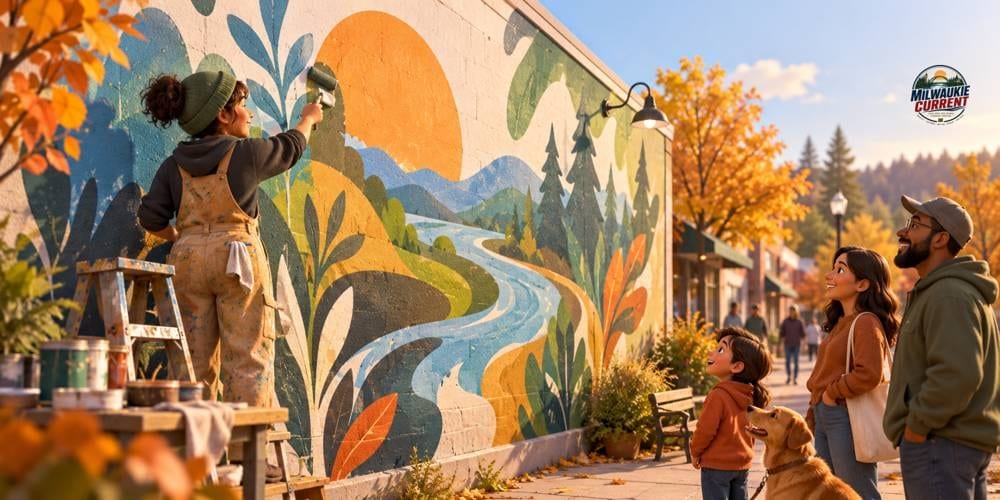
Milwaukie’s latest mural-focused public engagement page invites residents to notice the art around them and share which murals they have visited. It also explains something a finished wall does not show: the planning, community review and maintenance involved in bringing public art into a neighborhood.
The city’s Milwaukie Minute: Murals Around Town describes a process that begins with discussion of the artwork, site, funding and building-owner approval. A proposal then becomes a public conversation rather than simply a private decision about a blank wall.
The page says public posting precedes review, and that the Arts Committee considers the work in its surroundings. Long-term care matters too. The city describes an owner’s maintenance commitment, a reminder that a mural remains part of the street after its opening moment has passed.
For a reader walking around town, that process adds another way to look. Notice how an image relates to the building and the route past it. Does it reveal something you had not noticed about the space? Does the scale invite a closer look? These are suggestions for enjoying art, rather than claims about what any particular artist intended.
The city also draws attention to the Welcome to Milwaukie mural by Jeremy Okai Davis at the water tower reservoir, 4107 SE Harrison Street. Its page describes recent additions. Readers who know the earlier work may find that a familiar image rewards a fresh visit.
Public art can become part of how people give directions or remember a place. Someone may know a wall’s colors before they know the street name. That is an observation about the experience of encountering art, not a substitute for learning the artist’s name or the work’s history.
Another stop is the set of historical mural panels described by Travel Oregon. Its listing identifies panels near Adams Street west of 21st Avenue and Main and Jackson. Check the listing when planning a visit rather than assuming every mural is in the same location.
If a mural catches your attention, consider looking for its title and artist information. Crediting the person who made the work helps keep a public image connected to its creator. A photograph of a mural and permission to reuse that photograph are also separate questions, especially for a publication or business.
For anyone considering a mural project, the city’s explanatory page is an introduction, not an approval. The official art-mural provisions distinguish types of work and set out the applicable process. Contact the city for project-specific guidance rather than treating a newsletter summary as a permit.
The useful next step for most readers is simpler: choose a mural to notice, learn something about it and take the city’s quick poll if you wish. A short walk can be an opportunity to pay closer attention without needing to become an expert in art policy.
Sources: City of Milwaukie — Milwaukie Minute: Murals Around Town · Travel Oregon — Milwaukie Historical Murals · Milwaukie Municipal Code — Art Mural Provisions
Discussion transparency: Some discussion prompts below are AI-generated by Milwaukie Current. They are not reports of reader attendance or personal experience. Reader-submitted comments may also appear. |
6 Comments
Join the conversation
I like public art as much as anyone but the process described here sounds like it could take forever. By the time a proposal gets through discussion, public posting, arts committee review and owner approval the moment for a neighborhood might have passed.
Good reminder that photographing a mural and being allowed to use that photo commercially are two different things. A lot of people do not think about that at all.
My kids use the mural near Main and Jackson as a landmark when we drive through. They call it the history wall. Had no idea there were multiple panels. We might have to find the others now.
The part about maintenance commitments is interesting. There are a couple murals around town that are starting to fade and peel pretty badly. Curious if the city actually follows up on that or if it just kind of gets forgotten after the ribbon cutting.
Appreciate that they explained the approval process. I always wondered how a mural ends up on a building versus just being someone's decision to paint whatever they want on their own wall.
I walked past the water tower mural on Harrison probably a dozen times before I actually stopped and looked at it. Glad the city is pointing people back to it. The recent additions are worth seeing up close.